The Strange Story Behind the Third Verse of “The Love of God.”
The Verse That Traveled a Thousand Years. Its story stretches across continents, centuries, languages, and even the walls of a forgotten prison. It is a hymn assembled like a mosaic
Mark Gedeon
12/9/20254 min read
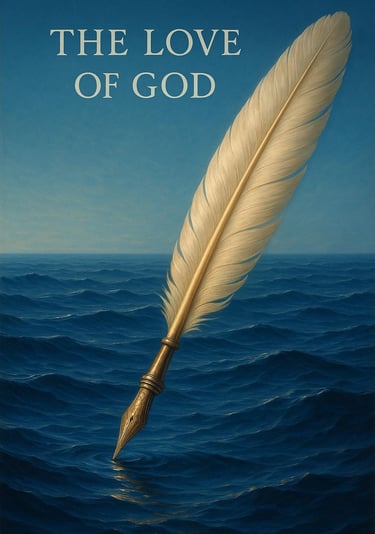
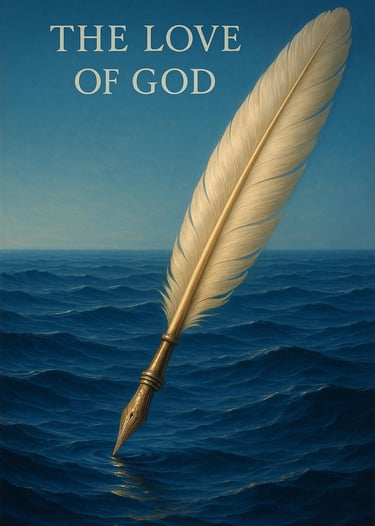
The Mysterious Story Behind “The Love of God”: The Verse That Traveled a Thousand Years
Some hymns were written in a single breath; a moment of inspiration captured on paper. The Love of God is not one of those hymns. Its story stretches across continents, centuries, languages, and even the walls of a forgotten prison. It is a hymn assembled like a mosaic: two verses written in 1917 by a fruit-packer with a stub pencil… and one verse that may have been born in a medieval synagogue nearly a thousand years earlier. And somehow, mysteriously, providentially, these fragments found each other. And together they proclaim the immeasurable love of God.
Frederick M. Lehman wasn’t a well-known composer. In 1917, he was working in California packing oranges and lemons into wooden crates. Life had dealt him several setbacks, and long hours of manual labor were simply a way to get by.
As he was working, he reflected on something he had heard earlier that year at a camp meeting. A preacher had closed his sermon by reciting a set of lines.
Could we with ink the ocean fill,
and were the skies of parchment made…
Lehman wrote that the words “burned in my soul.” Words so sweeping and majestic that he couldn’t shake them. So, he sat down with his daughter and began creating a hymn to wrap around those lines - new verses, a chorus, and a melody worthy of such grandeur.
Lehman later heard a version of the story behind the verse that the preacher shared at the camp meeting, but there was more to tell.
The story most often told begins not in a church, but in an institution. Sometimes described as a prison, sometimes an asylum. The details shift depending on the version, but the core remains the same.
Sometime in the late 19th or early 20th century, workers were repainting the walls of a cell after the occupant had died. On the wall, written in pencil, some say scratched, were these words:
To write the love of God above
Would drain the ocean dry…
Instead of painting over the lines immediately, someone copied them down. They were too striking, too poetic to lose. The words circulated, eventually appearing on a card or leaflet. That card made its way to the preacher who quoted it at the camp meeting Lehman attended.
A fragment, rescued from obscurity.
A verse instilled with the awe of God
A poem, author unknown.
But that’s only half the mystery.
Years later, scholars began noticing similarities between the asylum-wall verse and an ancient Jewish poem known as Haddamut (or Akdamut in some traditions). This poem was written in Aramaic by a Jewish cantor named Meir ben Isaac Nehorai around the 11th century.
One section of Haddamut contains imagery remarkably close to the hymn:
“If all the heavens were parchment,
And all the trees were pens,
And all the seas were ink,
It would still not suffice to write
The greatness of God.”
The style differs—ancient Aramaic rather than English poetry—but the core metaphor is unmistakable: God’s greatness is infinite; the world itself is too small a canvas for His glory.
So how did a medieval Jewish poem end up on the wall of a modern institution?
We don’t know.
Some believe the inmate had Jewish heritage and knew the poem. Others think he may have encountered an English paraphrase. Still others suggest the lines may have circulated orally within Christian circles, detached from their original source.
The truth is lost to history. The mystery remains. But the message survived. Lehman’s two additional verses match well the tone by describing God’s love breaking through human failure and redeeming sinners. The third verse, whether penned by an anonymous prisoner or first sung by an 11th-century cantor, has impact: it pulls our imagination to its limits. It tries to measure the immeasurable.
Could we with ink the ocean fill… Picture the ocean. Not a cup of ink. Not a bottle. The unfathomable depths of the ocean.
…And were the skies of parchment made… The entire dome of the heavens, horizon to horizon, turned into a scroll for the scribe of the universe.
Were every stalk on earth a quill… Every blade of grass, every reed, every stem—millions upon millions—sharpened to write a single story.
And every man a scribe by trade… Humanity united in one task: describing the love of God.
What then? To write the love of God above would drain the ocean dry.
Even if every ocean were ink, it would not be enough. Nor could the scroll contain the whole, though stretched from sky to sky.
God is too great to be fully known. Paul writes in Ephesians 3 of “the love of Christ which surpasses knowledge.” The psalmist says, “Thy mercy, O Lord, is in the heavens; thy faithfulness reacheth unto the clouds” (Psalm 36:5).
Somehow, this verse was preserved for us, added to with further revelation, and wrapped in music as a gift for worship.
When we sing The Love of God, we stand in a long line of worshipers:
a rabbi in the medieval city of Worms,
a forgotten inmate writing on a cell wall,
a weary fruit-packer humming at his kitchen table,
generations of believers lifting their voices in awe.
All of them reaching—impossibly, beautifully—for words big enough to describe a God whose love is bigger still. Our words will always fall short. Our understanding will always be limited. But the love of God is not. It reaches back a thousand years. It reaches into forgotten places. And today, it reaches you.
Could we with ink the ocean fill… Even then, it would not be enough.
If you would like to see the words and music to The Love of God, click here https://hymnary.org/media/fetch/116976
Read some of our other blogs: https://arrowbanyan.com/blog-list